


By Nella Nelson –
They “fly” smoothly through the water, flapping around the intertidal waters near rocks and kelp beds. If you look closely enough at the shallow waters, especially along the walkways of Ventura Harbor, you’ll see these graceful creatures that surprise many a Ventura resident.
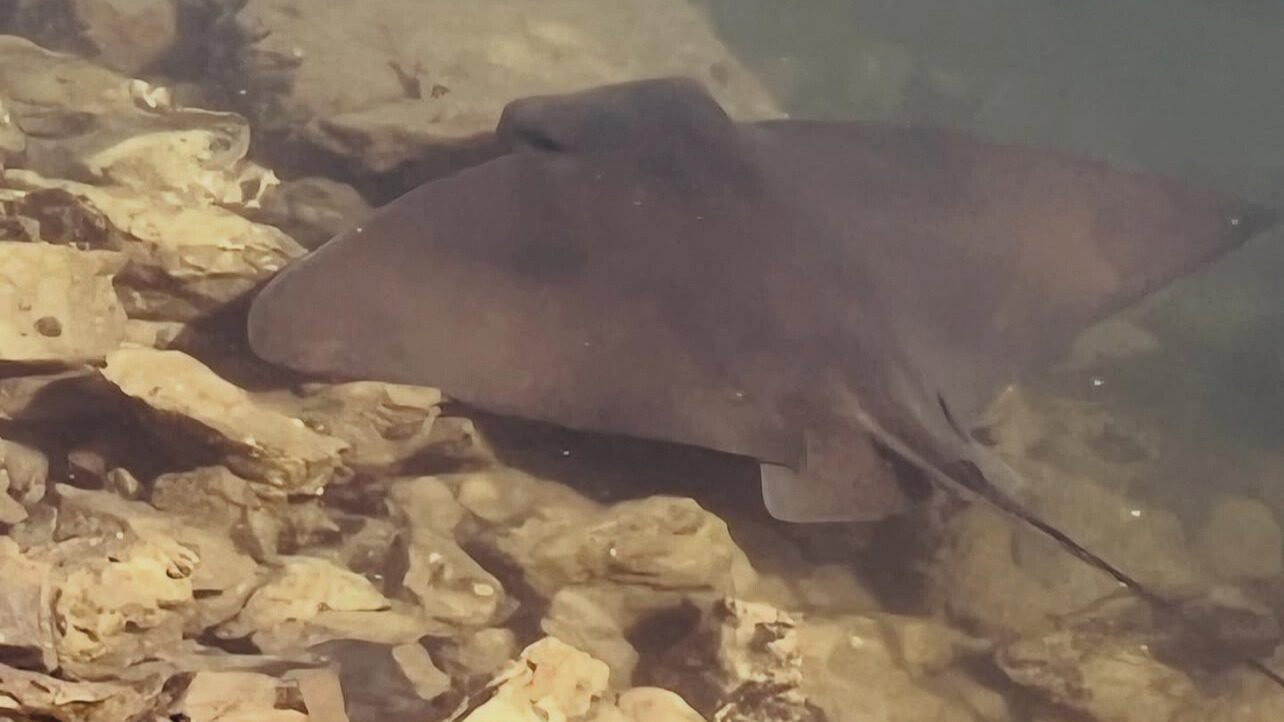
With a heavy raised head and triangular shaped body, the bat ray has a dorsal fin at the base of its long whip-like tail and a stinger behind it. Their color can range from blackish to blackish-brown, to brown, with white underbellies. At their largest, bat rays have been reported to weigh up to 200 lbs. with a size of up to six feet across. The official world record of a caught bat ray weighed in at 181 lbs. at the Huntington Beach Pier in 1978 by a high school student named Bradley Dew.
The bat ray; also known as sea ray, eagle ray, mud marlin, and monkey face ray, can be found from southern Baja to Yaquina Bay, Oregon (and along the Galapagos Islands). Their species name is Myliobatis Californica, meaning in Greek: Tooth + arrow/poison and ray + location. In Mexico, the bat ray is known as raya murcielago or tecolote (owl).
Bat rays grow slowly and reach sexual maturity relatively late. Females tend to grow bigger than males. With a life span of 24 years, many full-grown females are mothers, grandmothers and even great grandmothers. In reproduction, they copulate while swimming with synchronized wing beats, the male under the female. Eggs are retained by the female and hatch inside of her in a process that resembles a live birth. Litters range from two to ten pups. The pups emerge headfirst with their pectoral fins wrapped around the body. Scientists report that the rays move into inshore waters to breed during the summer then move offshore in the winter. While inshore, they can be found in large concentrations, sometimes several thousand on the ocean floor.
Bat rays can live anywhere from the water surface to 150 feet below and are mostly concentrated within 8 to 100 feet below the surface. They prefer a flat, rocky bottom or sand among rocks. They feed on a wide variety of foods with most of their intake being oysters, clams, crabs, shrimp, abalone, snails and worms. Using their pectoral fins, they lift their bodies rapidly up and down to create a suction that sweeps away the sand to gain easy access to their food on the bottom. They also use their snout to dig trenches to expose buried prey, such as clams.
The bat ray’s teeth are flat and pavement-like, with tightly packed rows for crushing and grinding their prey. They eject the shells and consume the flesh. Their teeth are capable of crushing the toughest of clam and crab shells.
Bat ray predators are several types of marine mammals, including white sharks and sea lions. Several aquariums contain pet-able bat rays. Yes, they can become rather pet-like, as the ones found at Monterey Bay Aquarium and Aquarium of The Pacific. In these cases, their stingers are removed and the venomous spines cut off once a month. This does not harm the ray as the spines are made of keratin and grow back, much like human nails.
Bat rays’ spines can inflict painful wounds, especially if stepped on. Some bat rays even have two or three stingers. Shuffling your feet on the ocean floor is recommended when entering a calm shore or bay, which scatters them away.
Keep an eye out during mid to late summer and you may spot a bat ray around a pier or within a marina.
Sources:
https://www.pierfishing.com/bat-ray. Martin, Linda K., and Gregor M. Cailliet. “Aspects of the Reproduction of the Bat Ray, Myliobatis Californica, in Central California.” Copeia, vol. 1988, no. 3, 1988, pp. 754–62. JSTOR, https://doi.org/10.2307/1445398. Accessed 29 July 2025. https://www.nps.gov/rlc/pacificcoast/bat-rays.htm
