


By Marion McParland –
Margery’s Spielman’s profound love for the ocean began while growing up in the San Fernando Valley where she paddled around in swimming pools as a baby in a tiny life jacket. “I’ve always had a love affair with water.” she says. When Margery was five, she’d saved up enough money in her piggybank to buy a wading pool. And in those shallow waters, a deep, lifelong passion was born. “Wherever there was water,” Margery laughs, “I had my mask and fins ready.”
Her true awakening was in 1956 at the age of eight, flipping through a National Geographic magazine. When she came to an article written by Jacques Cousteau and saw him underwater with his divers, befriending a giant grouper fish named Ulysses, she had an epiphany. “Those photos were magic windows into my future,” she said. “From that moment on, I knew I wanted to be a scuba diver and be part of his team.” Those images crystallized her lifelong dream that would eventually become her reality.
Making that dream come true took tremendous persistence. At 16, Margery pleaded with her overly protective father to let her learn to scuba dive. Concerned about his teenage daughter driving alone to night classes in Santa Monica, he would only agree to let her go if she could find a friend to join her.
Margery immediately called her closest companions – but not one of them shared her diving enthusiasm. “The only underwater experience they were interested in was the submarine ride at Disneyland,” she recalls with a laugh. “He finally agreed to let me go by myself, but it took a lot of my heartfelt tears for him to realize that scuba diving was my true calling.”
In the scuba diving class, Margery was the only young woman among a group of older men – a dynamic that would repeat itself throughout her early diving career. “It was the men’s club,” she explains. “They were spearing fish and bagging lobsters, and here I was, a naïve 16-year-old girl.” During her first open-water dive, the equipment was ill-fitting, designed for the men who dominated the sport. But the moment she slipped beneath the surface, Margery became enchanted by the sheer beauty of the underwater world around her. “I just wanted to marvel at everything,” she says. “It was like crossing into another world — a surreal, weightless journey into liquid magic. That Christmas, Santa gave me my first wetsuit. Then, on my birthday, the big surprise was an underwater camera.”
“I followed the water, and my dreams,” says Margery. “I let my heart go with the current and tried to follow in the wake of my hero, Captain Cousteau. I read all his books and watched every one of his televised films.
With fierce independence, Margery forged her own path. At 17, she got a job, left her family home and moved into a studio apartment. To make ends meet, she spent weekends beach diving for lobsters and abalone. Sometimes her freezer was filled with lobsters – yet she couldn’t afford to buy butter!
Then she began working at a local dive shop – one of the first to carry underwater photographic equipment. “The owner, Col. John D. Craig, was a pioneer diver and underwater cinematographer, like Cousteau. In the 1950s, he had a television show called Danger Is My Business,” she says. So, besides going on the dive boats for free, many of the shop’s clients were professional Hollywood filmmakers.
“Those photos were magic windows into my future. From that moment on, I knew I wanted to be a scuba diver and be part of his team.”
— Margery Spielman
Her natural comfort in the water and her striking California presence quickly caught the attention of one of the shop’s regular customers, who hired Margery to star in a 1969 episode of Bill Burrud’s “The Challenging Sea” television series. From there, she began modeling for diving equipment catalogs and soon transitioned into television and film. In the ‘70s, she lived and worked in a Hollywood studio and was able to join the Screen Actors Guild as a stunt diver for television and underwater film production.
Along the way, she also became a NAUI and PADI diving instructor in the 1980s and taught scuba and oceanography courses at Ventura Community College and Ojai Valley School. Margery is also an accomplished artist and has exhibited her artwork in numerous Marine Art Expos, including Maui, Kauai, Pebble Beach and Paris. Her work is in the collections of the late Jacques Cousteau, Jean-Michel Cousteau and the late Mikhail Gorbachev.
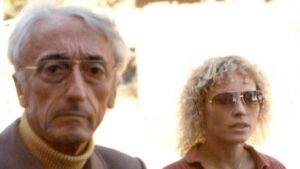
By the late 1970s, Margery began freelancing for The Cousteau Society, working on special projects including still photography, public speaking and illustration. She designed the distinctive logo for their Parc Océanique Cousteau in Paris, France, and in 1987, she did the research and logistics for the two-hour television special on the California Channel Islands, entitled, “At the Edge of a Human Tide.”
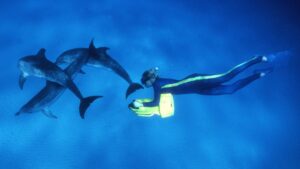
Her dedication and persistence finally paid off when she was invited to join the Cousteau Diving Team on a dolphin expedition in the Bahamas. Becoming one of the crew’s first three female divers was an incredible milestone in an era when women were rarely accepted into professional diving.
Her expeditions were nothing short of magical. On nine separate trips to Grand Bahama Island, she had thrilling interactions with Atlantic spotted dolphins. On her first expedition, they soon discovered that the dolphins responded more enthusiastically to the women’s higher-pitched vocalizations.
Margery describes how these intelligent marine mammals recognized her, year after year. One female dolphin even brought her newborn calf right up to Margery, knowing that she would not try to touch her baby. “I visited them over a 10-year span so the babies grew up knowing us and the only time we’d ever touch them was when they would come and touch us, overtly encouraging us to physically interact,” she says.
During a Cousteau expedition filming humpback whales off the coast of Maui, Margery was snorkeling when she dove toward the bottom – and found herself face-to-face with a mother and her newborn calf. “The baby’s eyes were quivering with excitement. I was quivering too,” she said. “The mother’s eye was dark and mysterious, yet when our eyes met, I felt a calming energy as though I was in the presence of a wise old soul.”
In 1995, John Prince, lead naturalist for the Channel Islands programs, recommended Margery to Elderhostel founder Marty Knowlton to teach a new program, Myths, Monsters and Mermaids. “I nervously studied up for my interview with Marty,” Margery laughs, “but halfway through, he told me, ‘It wasn’t an interview, you’re already hired.’”
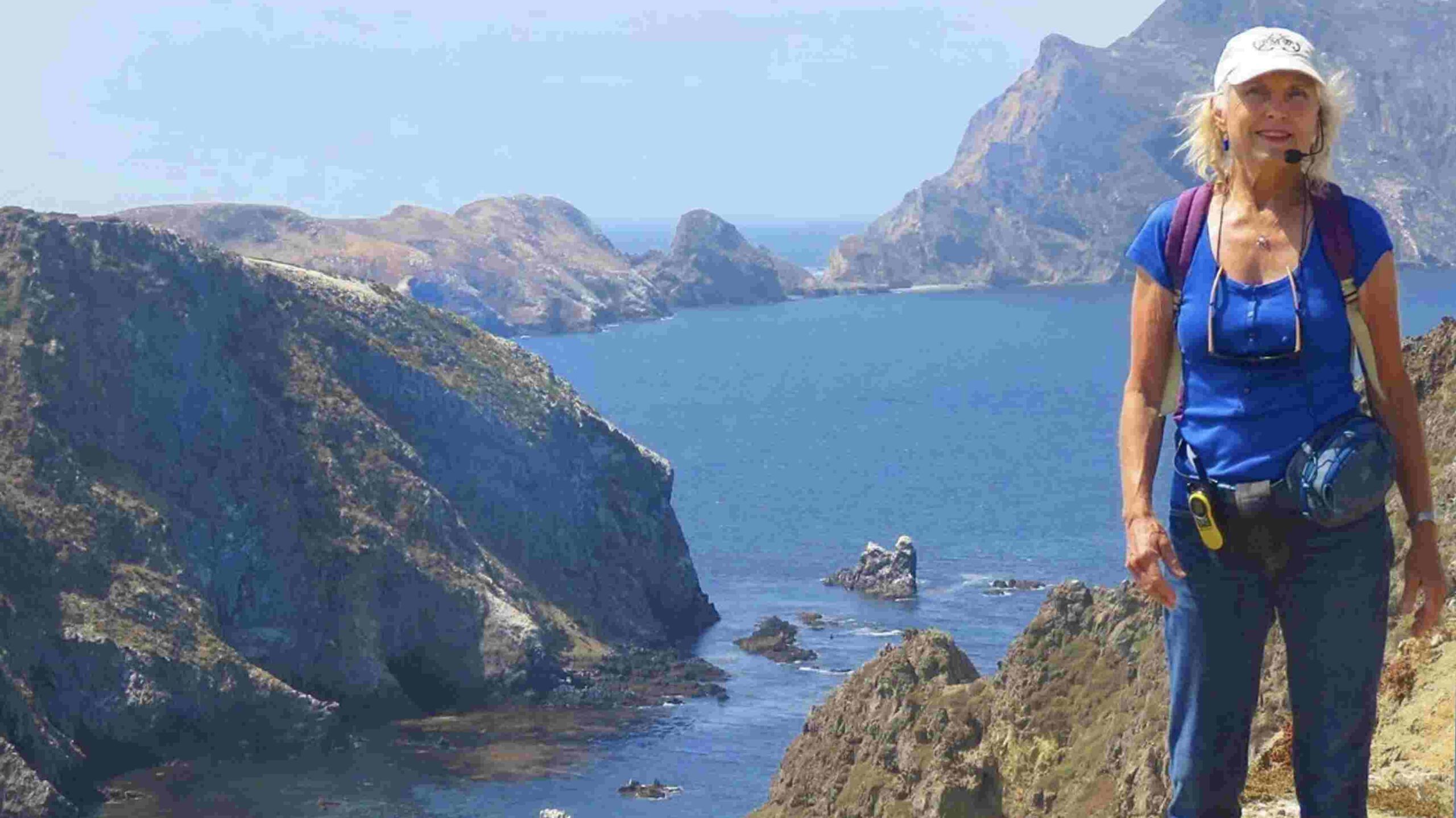
Margery went on to teach Remembering Cousteau, Swimming with Whales and Dolphins and The Kelp Forest. When John decided to retire, he began mentoring Margery to take over the Channel Islands programs. “I spent about a year collaborating with him on the islands, learning the trails and the environment, and developing my own slide presentation.” she says. “Then, when he officially retired, I became the lead naturalist for all of Road Scholar’s Channel Island programs.”
Just off Southern California’s coast, five of the archipelago’s eight islands comprise the Channel Islands National Park (Anacapa, Santa Cruz, Santa Rosa, San Miguel and Santa Barbara). For three decades, Margery shared the wonders of this living classroom with well over 20,000 Road Scholars – not just teaching facts and figures – but making learning fun. “I’ve been greatly inspired by my Road Scholars’ spirit of adventure and passion for learning.”
To Margery, the Channel Islands – often called the “Galápagos of North America” – aren’t just a workplace, they’re a sanctuary. “The Channel Islands are like old friends,” she explains. “I’ve seen the islands in all their seasons and moods – the rain, the fog, the hail, the sun. I have favorite trees and plants. I even have ‘conversations’ with a pair of ravens who I like to believe recognize me.”
“Taking people out to the islands, my intent has always been for them to be safe, to have fun, to learn new things and to make great memories,” Margery reflects. “It made me feel like I was giving them a gift. We all have our gifts. Some people have a hard time finding out what their gift is, and when they do, they don’t know how to share it. Thankfully, Road Scholar gave me the platform to share mine.”
Margery approached every learning adventure with infectious enthusiasm, eager to impart an understanding of how distinct elements of the environment rely on one another. Whether encouraging participants to plant milkweed to help our monarch butterflies or discussing the impacts of global warming, her focus was always on inspiring “reverence for life.”
“My hero, Captain Cousteau once said, ‘People protect what they love.’ I love these islands and I love Mother Nature, so, naturally I want to inspire in others the same passion I have for our environment. Over the years, my Road Scholars have certainly inspired me with their adventurous spirits and inquisitive minds,” says Margery. “I’ve learned so much from everyone. Having an insatiable curiosity myself, if I couldn’t answer a question, finding the answer became my next research project. Yet the job of a naturalist isn’t just knowing the names and facts about a place. What’s more important is understanding how all the myriad elements in a place are related to each other.” Taking her passion further, Margery also helped develop Road Scholar’s beloved Explore the Channel Islands With Your Grandchild program.
Margery has also written a book she hopes to publish entitled: “Wrapped in Blue – The Art and Memoirs of a Landlocked Mermaid,” with a foreword by longtime friend, Jean-Michel Cousteau (Capt. Cousteau’s oldest son). Through her book and her lasting legacy with Road Scholar, her core message remains consistently optimistic: Hold tight to hope and never abandon your dreams. She was also one of five woman who were recently inducted into the 2026 Women Divers Hall of Fame.
Margery passes on the torch to her friend and Road Scholar colleague, Dawn Brooks, and sets forth on her next challenging adventure, which is caregiving her husband, a Vietnam-era Marine veteran and former underwater cinematographer. Sadly, her equally adventurous partner has severe short-term memory loss and requires her fulltime help. “He’s still so sweet and kind, and he would have done the same for me,” she says. With energy as boundless as the tides, Margery plans to remain deeply entwined with the Channel Islands National Park. Since she lives at the beach near the harbor, she looks forward to an occasional jaunt out to Santa Cruz Island. “After all, I promised the ravens I’d stay in touch,” she says, winking.
“People protect what they love. I love these islands and I love Mother Nature, so naturally I want to inspire in others the same passion I have for our environment.”
— Margery Spielman
We celebrate Margery’s incredible journey that led her to our community – a story of breaking boundaries, exploring the undersea world and inspiring thousands to protect the oceans she holds so dear. She leaves a legacy defined by a profound curiosity for the natural world and a tireless dedication to lifelong learning.
Margery Spielman’s profound love for the ocean began in the San Fernando Valley, where she paddled around swimming pools as a baby wearing a tiny life jacket. “I’ve always had a love affair with water,” she says.
By the time Margery was 5 years old, she had saved enough money in her piggy bank to buy a wading pool. In those shallow waters, a lifelong passion was born. “Wherever there was water,” Margery laughs, “I had my mask and fins ready.”
Her true awakening came in 1956 when, at age 8, she discovered a National Geographic article about Jacques Cousteau. Seeing photographs of Cousteau and his divers underwater — including an image of them interacting with a giant grouper fish named Ulysses — changed the course of her life.
“Those photos were magic windows into my future,” she says. “From that moment on, I knew I wanted to be a scuba diver and be part of his team.”
Making that dream a reality required determination. At 16, Margery convinced her protective father to allow her to take scuba diving classes in Santa Monica. His biggest concern was his teenage daughter driving alone to night classes, and he agreed only if she could find a friend to join her.
Margery quickly discovered none of her friends shared her enthusiasm for diving. “The only underwater experience they were interested in was the submarine ride at Disneyland,” she recalls with a laugh. Eventually, after many heartfelt conversations, her father agreed to let her pursue her dream.
In her scuba class, Margery was the only young woman among a group of older men — a pattern she would encounter throughout her early diving career.
“It was the men’s club,” she says. “They were spearing fish and bagging lobsters, and here I was, a naïve 16-year-old girl.”
Despite the challenges, the moment she entered the ocean, she knew she had found her place. “It was like crossing into another world — a surreal, weightless journey into liquid magic,” she says.
That passion led to a career filled with adventure. Margery worked at one of the first dive shops to carry underwater photographic equipment, where she met professional filmmakers and divers, including pioneer underwater cinematographer Col. John D. Craig.
Her comfort in the water and natural presence in front of the camera led to opportunities in television and film. She appeared in a 1969 episode of Bill Burrud’s The Challenging Sea, modeled for diving equipment catalogs and later joined the Screen Actors Guild as a stunt diver for television and underwater film productions.
Margery also became a NAUI and PADI diving instructor in the 1980s, teaching scuba and oceanography courses at Ventura College and Ojai Valley School. As an accomplished marine artist, her work has been exhibited at Marine Art Expos in locations including Maui, Kauai, Pebble Beach and Paris. Her artwork is held in the collections of Jacques Cousteau, Jean-Michel Cousteau and the late Mikhail Gorbachev.
By the late 1970s, Margery began working with The Cousteau Society on special projects involving photography, public speaking and illustration. She designed the logo for the Parc Océanique Cousteau in Paris and contributed research and logistics for the two-hour television special At the Edge of a Human Tide about the California Channel Islands.
Her lifelong dream came full circle when she was invited to join the Cousteau Diving Team on a dolphin expedition in the Bahamas. She became one of the team’s first three female divers during an era when women were rarely accepted in professional diving.
During nine expeditions to Grand Bahama Island, Margery developed remarkable relationships with Atlantic spotted dolphins. She recalls how the dolphins recognized her over the years, including one female dolphin that introduced her newborn calf.
“The only time we’d ever touch them was when they would come and touch us, overtly encouraging us to physically interact,” she says.
During another Cousteau expedition filming humpback whales off Maui, Margery experienced a moment she will never forget. While snorkeling, she encountered a mother whale and her newborn calf.
“The baby’s eyes were quivering with excitement. I was quivering too,” she says. “The mother’s eye was dark and mysterious, yet when our eyes met, I felt a calming energy as though I was in the presence of a wise old soul.”
In 1995, Margery began teaching programs through Road Scholar, including Remembering Cousteau, Swimming with Whales and Dolphins and The Kelp Forest. She eventually became the lead naturalist for Road Scholar’s Channel Islands programs, sharing the wonders of the islands with more than 20,000 participants over three decades.
The Channel Islands — often called the “Galápagos of North America” — became more than a workplace for Margery. They became a place she cherished deeply.
“The Channel Islands are like old friends,” she says. “I’ve seen the islands in all their seasons and moods — the rain, the fog, the hail, the sun.”
Through her teaching, Margery hoped to inspire curiosity and environmental stewardship.
“People protect what they love,” she says, quoting her hero Captain Cousteau. “I love these islands and I love Mother Nature, so naturally I want to inspire in others the same passion I have for our environment.”
Margery also helped develop Road Scholar’s Explore the Channel Islands With Your Grandchild program and has written a book, Wrapped in Blue: The Art and Memoirs of a Landlocked Mermaid, with a foreword by longtime friend Jean-Michel Cousteau.
Recently inducted as one of five women into the 2026 Women Divers Hall of Fame, Margery now passes the torch to her friend and Road Scholar colleague Dawn Brooks while beginning a new chapter caring for her husband, a Vietnam-era Marine veteran and former underwater cinematographer.
Although her adventures have changed, her connection to the ocean remains strong.
Living near the harbor, Margery still looks forward to occasional trips to Santa Cruz Island. “After all, I promised the ravens I’d stay in touch,” she says with a wink.
Margery Spielman’s journey is a testament to following dreams, breaking barriers and sharing a lifelong love of the natural world. Her legacy lives on through the thousands of people she has inspired to explore, appreciate and protect the ocean and the Channel Islands.
