


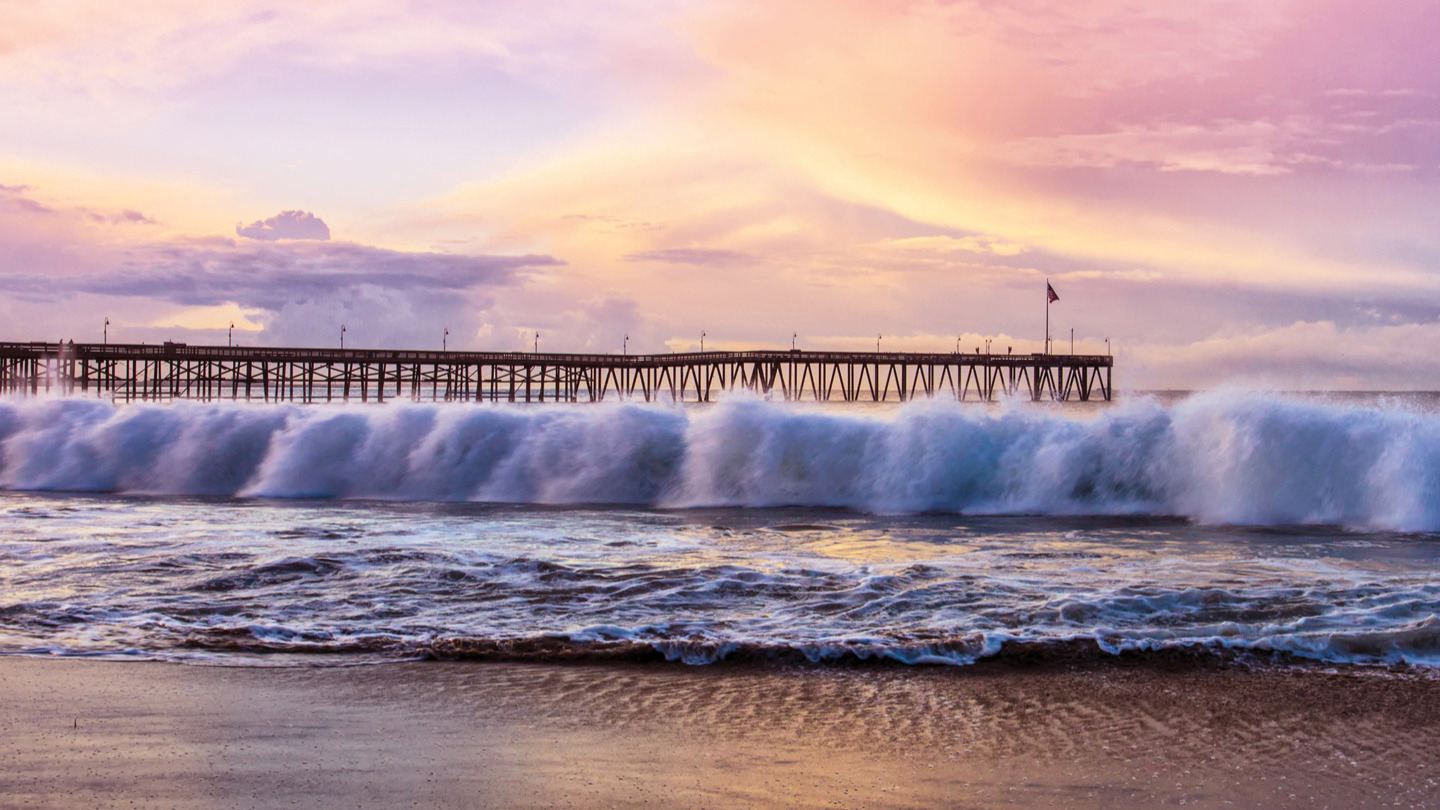
By Visit Ventura –
The Ventura Pier is, in many ways, Ventura’s centerpiece. Pronging out into the Pacific at the base of our folded hills, the Ventura Pier is visible from almost any high point in town. Walk Ventura’s beaches and, in the distance, it wavers like a child’s matchstick project. Sit on the sand at its base on a calm day and it whispers a lovely song any ocean and pier lover knows: quiet sighs and eternal lappings that are salve for the soul.
The Ventura Pier is living history, front and center. It is a fine thing to know where we came from. But there’s a lot about the Pier you may not know. So here are a few Ventura Pier facts – maybe even enough to make you a Ventura Pier expert.
- In the Beginning
The Ventura Pier was built in 1872. Construction took five months, and the Pier came in at 1,200 feet long at a cost of $45,000. At the official Pier opening ceremony, the Ventura Signal newspaper reported that “sparkling champagne was uncorked…flowingly.”
- Why Was the Ventura Pier Built?
In the 1860s, dirt roads linked the city of San Buenaventura to the outside world. When severe winter rains came, those roads became mud-slogging, axle-snapping nightmares. Adding insult to injury, the Ventura and Santa Clara rivers, to the north and south of the city, often became impassable.
The arrival of the railroad was still 20 years away, so passengers and freight came to Ventura mostly aboard ships. But with no wharf or pier, those ships anchored offshore, unloading and loading passengers and cargo aboard small barges called lighters. During heavy swells and bad weather, this could be a hair-raising enterprise.
During its heyday, from 1872 until roughly 1914, the Ventura Pier was a critical lifeline.
Ships would arrive at the Pier every 10 days or so, offloading and loading goods. The chief products shipped from the Pier included wheat, citrus, lima beans, seaweed, cattle, pigs, and crude oil. Products off-loaded onto the Pier included lumber, bricks, and cement.
- When Was Cargo Last Unloaded at the Ventura Pier?
The last cargo unloaded at the Ventura Pier was a load of lumber in 1940.
In fact, lumber was the biggest import in the Pier’s early years. Hauled into Ventura by horse-drawn wagons, the lumber was used to build much of the growing community.
- How Long Was the Ventura Pier?
In 1938, the Ventura Pier had the distinction of being the longest pier on the West Coast, reaching 1,958 feet – the longest length the Pier ever achieved.
- The Pier Has Taken Some Serious Pummeling
The most notable damage in recent years occurred in December 1995, when swells up to 18 feet high tore away approximately 420 feet of the Pier. The storm removed at least 22 horizontal support beams and 150 pilings, along with an $80,000 copper public art sculpture called “Wavespout,” which had been installed at the ocean end of the Pier.
The San Francisco artist who designed “Wavespout” told a reporter his goal was to “directly link the ocean and its rhythms to man.” In this, he was wildly successful.
- What Are the Pier’s Biggest Enemies?
Fire, wayward ships, waves, and beach erosion.
- Near Misses and Dead-On Hits
In 1874, the schooner Lucy Ann went aground near the Pier. A spring storm in 1876 sent the steamships Kalorama and Crimea ashore. Both vessels were later immortalized as Ventura street names.
In 1917, the S.S. Coos Bay achieved what the other vessels had not—cutting the Pier in half when a storm drove the ship into the structure.
- How Deep Are the Pilings?
Timber pilings are driven 12 to 20 feet into the ocean floor. The more recent steel pilings extend about 30 feet into the ocean floor.
The newer steel pilings themselves are 72 to 80 feet long, 16 inches in diameter, and weigh between 6,400 and 6,600 pounds.
- When Fishing from the Pier Wasn’t Enough
There was a time when Ventura fisherfolk climbed down dicey rope ladders to rowboats, where they fished the shallows around the Pier.
Their catches included Pacific mackerel, calico bass, yellowtail, croaker, white sea bass, barred perch, Pacific halibut, shark, corbina, smelt, and even barracuda.
- Who Looks Out for the Pier – and, With That, Ventura?
Unlike much of history, the Ventura Pier will not disappear into the mists of memory because somebody is looking out for it.
In 1993, a group of community leaders created Pier into the Future, a nonprofit organization that has since worked tirelessly to preserve, maintain, and enhance the Pier.
The finest kind of community undertaking, they continue to raise money – and they can always use help. For more information, visit www.pierintothefuture.org.
_________________________________________________________________________________________________________
Ventura’s Wharf
By Richard Senate –
The wharf in Ventura is now a place to fish, stroll, and enjoy the views and fresh air. But it was originally built as a practical window on the world, during an era before dependable roads and railroads. In the 19th century, coastal steamers were the best way to travel, bringing goods into Ventura and carrying the community’s produce and livestock to markets.
Mr. Joseph Wolfson raised the money to build the wharf, with help from his father-in-law, Juan Camarillo. Construction began in 1871, with the first piling christened with California wine by his daughter. The wharf was completed in 1872 at 1,200 feet long, making it the longest in California at the time. Ships landed here carrying cargoes ranging from bricks and apples to Christmas trees.
Despite its length, the pier had no breakwater. One was planned but never built, making it extremely difficult for ships to land during bad weather. Four ships were driven onto the beach and broken apart by the surf.
Three of the lost ships are memorialized in Ventura street names: Ann Street, named for the schooner Lucy Ann; Kalorama Street, named for the steamer Kalorama; and Crimea Street, named for the steamer Crimea, which was lost in 1876.
The Kalorama was carrying a cargo of live pigs when she went down. The animals scattered in an attempt to escape, and many were captured by local residents, who enjoyed plentiful barbecues that summer.
Another small ship, the S.S. Coos Bay, attempted to land at the wharf in December but was pushed through the pier by the surf and sank. She was carrying a cargo of Christmas toys.
Oil continued to be transported from the pier in small quantities until the 1930s. Eventually, shifting sands made it impossible for ships to land at the wharf. Today, the pier is used exclusively for recreation, but it retains a special place in Ventura’s history.
