


By Nella Nelson –
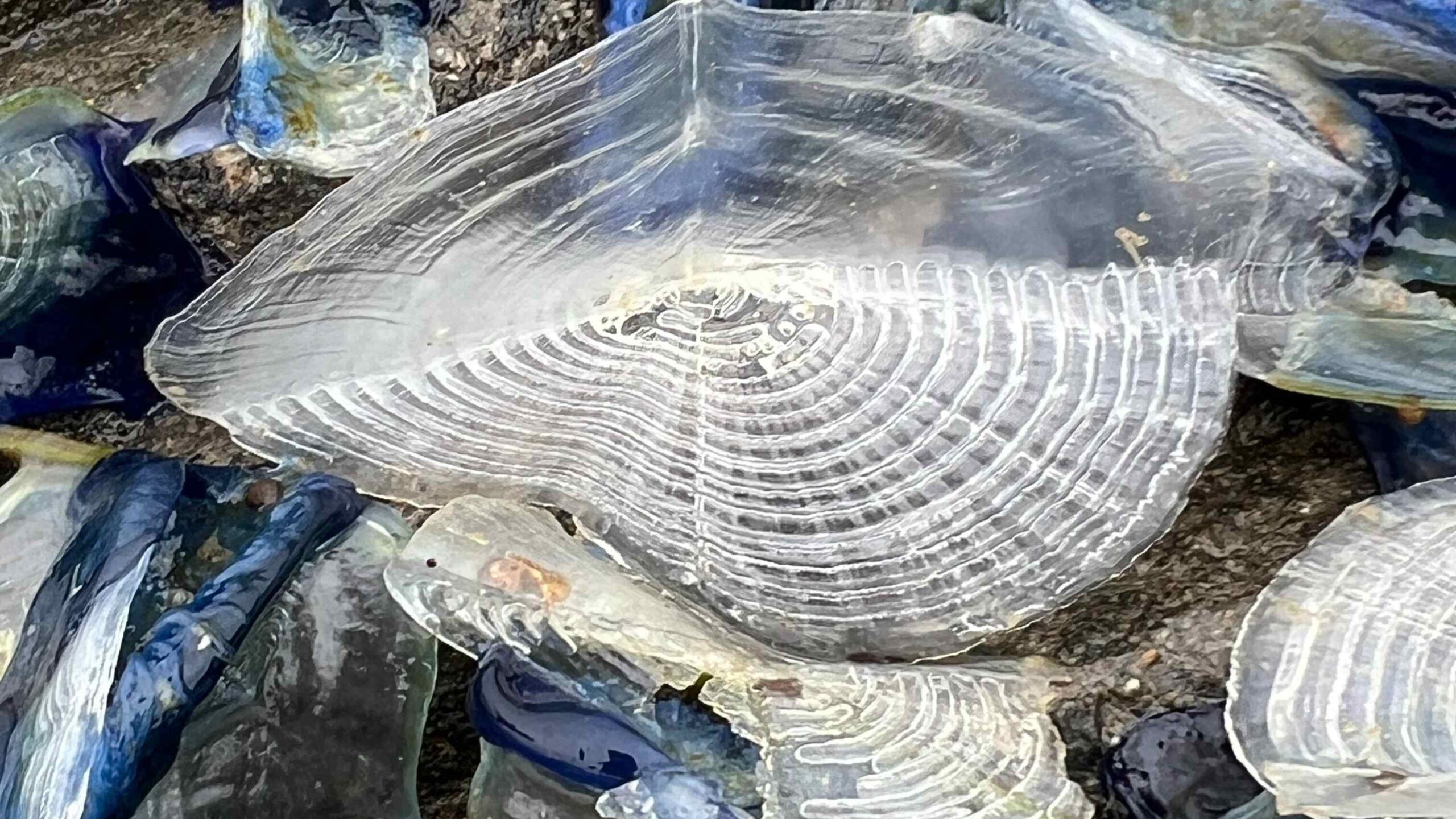
Like a wave of sea glass, they carpet our coasts in a glow of crystalline blue. Slowly drying out, they morph into a clear papery sail shape with an intricate spiderweb pattern across it. What exactly are these odd yet stunning creatures that visit our shores in the early spring?
Meet the Velella Velella (or By-The-Wind Sailors). Velella are not true jellyfish, but are related to jellyfish, as well as to sea anemones, corals, and hydroids. Velella is a genus of hydrozoa in the family Porpitidae. Its only known species is Velella Velella, a cosmopolitan free-floating hydrozoan that lives on the surface of the open ocean.
The Velella is a flat, oval-shaped creature, bluish to purple in color and three to four inches long. The body is relatively firm and contains a two-inch-high triangular “sail”. Dangling underneath its body are numerous blue tentacles which contain stinging cells to help capture the Velella’s food (mostly plankton). Their only known predators are sea slugs and purple snails. Velella’s stinging cells are rarely harmful to humans, as opposed to those of the Portuguese man o’ war.
The name “by-the-wind-sailor” is an actual misnomer for this little animal. Velella don’t actively navigate using their sail, although they are at the mercy of the winds as to where they travel. When the sail catches the wind, the Velella will be blown downwind at an angle to the wind. This sets Velella apart from many other jellyfish, which drift only with the ocean currents. When the prevailing winds shift, such as during a storm, the Velella are driven towards the coast, where they often are stranded on beaches in great numbers. As the Velella dries out on the beach, it becomes brittle and transparent, looking like a cellophane candy wrapper. Besides their sail, a striking feature of Velella is their blue pigmentation. Most animals that live on the surface of the water (Snails, jellies, fish) have blue pigmentation that serve as a combination of camouflage and protection from the sun’s rays. Dried animals on the beach lose their pigmentation and appear bleached white.
To reproduce, polyps on the underside of Velella’s disc create tiny medusae (the jellyfish-like part) asexually that bud off and sink to deeper water. The medusae will mature and then produce eggs and sperm, which will combine to grow into new polyps.
Most specimens are “left-handed” with the sail going from upper-left to lower-right along their long body axis, but a few are right-handed (Bieri, 1959). This design has led to speculation that there is a difference in preferred sailing direction in the northern and southern hemispheres, or on the eastern and western shores of oceans, depending on prevailing winds.
The Velella Velella begins its life in the middle of the Pacific Ocean, though the distribution of its dimorphic form (or different form of same species) also takes place in the Mediterranean and Atlantic. It remains on the surface of the Pacific most of its life, never coming close to the ocean floor. The only stage of its life completely submerged under water is at the larval stage.
Next time the Velella Velella swarm arrives, take a closer look at their detailed beauty. An up-close glance will reveal a photo-worthy work of art and a surprising pop of color.
https://www.nps.gov/pore/learn/nature/otherinvertebrates-velella.htm
https://jellywatch.org/velella
