


By Ventura Breeze Staff –
Expedition by Oceana and Blancpain Identifies Thousands of Species, Many Undescribed by Science
New research findings by Oceana, in collaboration with marine geneticist Dr. Adrian Munguia-Vega and in partnership with prestigious Swiss watchmaker, Blancpain, detected more than 11,000 unique species in California’s Channel Islands, showcasing the incredible diversity of marine life in the region, including thousands of species potentially unknown and undescribed by science.
In spring 2024, Oceana embarked on a research expedition—one in a series of three—to explore and document ocean biodiversity and vulnerable species off Southern California to better protect this special ecosystem and the marine life that makes these ocean waters globally important.
During the five-day expedition around the Channel Islands, the groups collected water samples at shallow sites (less than 52 ft deep) while scuba diving, and at deep locations (197–337 ft deep) using specialized sampling equipment. The water samples were filtered on the vessel, preserved, and later analyzed in a lab.
Ocean life that calls these waters home, or traverses through, leaves behind trace amounts of genetic material in the water (such as mucus, skin, scales, and feces)—called environmental DNA (eDNA). DNA segments from each organism contained in the water samples were isolated, amplified, and sequenced in a lab and compared to a DNA database—akin to matching human fingerprints.
“It is exciting to be advancing our understanding of ocean biodiversity in this region,” said Caitlynn Birch, Oceana’s campaign manager and marine scientist. “The amount of information we can glean about our ocean ecosystems from a small amount of seawater is staggering. The results of our expedition research are inspiring and surprising. While the Channel Islands are already known to have international biodiversity significance, our results increase our knowledge of the species known to occur there and highlight how much we still don’t know about our oceans. Many of the species detected by the eDNA analysis are poorly understood or could be completely unknown by science, elucidating how much of our marine ecosystems are still a mystery.”
These species likely play critical roles in healthy and functional ecosystems through supporting marine food webs and nutrient cycling. As human impacts and climate change continue to affect our oceans, these kinds of results are critical for understanding how ocean ecosystems are changing over time. It is exciting to be at the forefront of this new technology and growing the eDNA library that is reshaping our understanding of our oceans.”
“Our understanding of marine biodiversity, even in well-studied areas like the Channel Islands, is being revolutionized by technologies such as environmental DNA,” said Adrian Munguia-Vega, founder and director of the University of Arizona’s applied genomics lab. “These cutting-edge methods are revealing that the number of species present in marine ecosystems vastly exceeds previous estimates based on traditional techniques. Even in pelagic environments once perceived as barren, we’re discovering a hidden world teeming with life.”
This revelation has profound implications for our comprehension of marine ecosystem complexity. We’re uncovering entire branches of the tree of life that are not only hyperdiverse and ubiquitous but also largely unknown in terms of their identity and ecological roles. This discovery is simultaneously humbling and inspiring. The presence of such high diversity is a hallmark of healthy and resilient ecosystems, suggesting that our oceans may be more robust than previously thought. However, it also underscores the vast gaps in our knowledge and the urgent need for further research and conservation efforts.
The eDNA analysis detected 11,211 unique species of which 20% (2,209 species) did not have an eDNA match in the genetic library, meaning these species remain poorly understood and their DNA has not been sequenced. Researchers detected a total of 150 distinct species of fish, of which 34 were identifiedas species known to be in this region and many other species that cannot yet be identified to the species level, or were identified as a close relative of a species previously documented for this region, highlighting the need for further research and expanded genetic libraries.
The eDNA analysis identified a diversity of marine life several orders of magnitude larger than what can be observed during scuba surveys, including microscopic species and cryptic fish species that are harder to see by divers. However, the scuba dive surveys also documented species not seen in the eDNA—together, these complementary tools used in tandem create the most holistic snapshot of marine diversity.
The expeditions support Oceana’s efforts to expand the understanding of biodiversity in the Channel Islands and protect marine life at risk from entanglement in fishing gear. Notably, set gillnets continue to be used in state waters around the Channel Islands despite previous gillnet bans up and down the California coast.
These nets, used to catch California halibut and white seabass off Southern California, can be over a mile long—up to 20 football fields—and are one of the most indiscriminate fishing gears used in the United States. More than 100 species of ocean animals, including previously overexploited species such as giant seabass and tope sharks, have been documented in the catch from these nets.
Oceana and Blancpain collected eDNA samples during a second expedition to the Channel Islands in September 2024, which are currently being analyzed. A third expedition is planned for fall 2024 to expand the geographical range of the eDNA sampling.
Learn more at www.oceana.org.
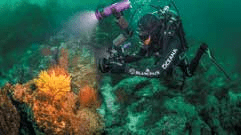
Scientific diver Geoff Shester films red gorgonian corals and California golden gorgonian coral off Santa Cruz Island.
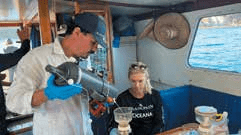
Oceana marine scientist Caitlynn Birch and Dr. Adrian Munguia-Vega filter water samples aboard the expedition vessel for eDNA analysis later in a lab.
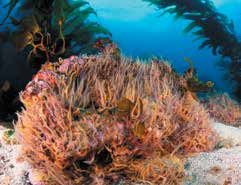
Brittle stars in a kelp forest.
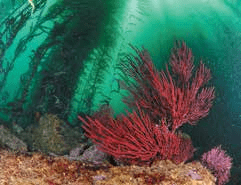
Brown gorgonian coral below a giant kelp forest off Santa Barbara Island.
